Multidimensional Data Modeling and Schema Designs for Data Warehouses
Verified Concept Article • Factual Traceability Enabled
Summary OverviewMultidimensional data modeling structures warehouse data into fact‑centric cubes and various schemas—star, snowflake, and fact constellations—to support efficient analytical querying.
Overview
Multidimensional data modeling is the cornerstone of modern data warehouses, providing a logical view that organizes data as a data cube—a lattice of cuboids that enables analysts to slice, dice, and aggregate information across several perspectives. This approach aligns with the subject‑oriented nature of warehouses, which focus on domains such as customers, products, and sales rather than on operational transaction processing. The model underpins the extraction, transformation, and loading (ETL) pipeline, ensuring that disparate source systems are integrated, cleaned, and presented in a consistent, decision‑support format.
Multidimensional Data Model
At its core, a multidimensional model separates facts (quantitative measures like dollarssold or unitssold) from dimensions (contextual attributes such as time, item, or branch). The fact table stores the measures together with foreign keys referencing each dimension table, forming the central hub of a star‑shaped schema. Dimensions are often hierarchical; for example, a time dimension may contain day, week, month, quarter, and year levels, while an item dimension can include item_name, brand, type, and supplier information. The collection of all possible aggregations of a base cuboid constitutes the data cube, with the apex cuboid representing the highest‑level summary.
Conceptual Modeling Using Star Schemas
The star schema is the simplest and most widely adopted representation. As illustrated in the example diagram, a single sales fact table is linked directly to denormalized dimension tables (time, item, branch, etc.). This flat structure minimizes join complexity, enabling fast query performance for OLAP tools. The sub‑article Conceptual Modeling Using Star Schemas expands on how to identify business processes, define measures, and design dimension attributes that capture the required granularity for reporting.
Schema Variants in Dimensional Modeling
While the star schema offers performance advantages, real‑world warehouses often require more nuanced designs.
- Snowflake schema: Normalizes selected dimensions into multiple related tables, turning hierarchical attributes (e.g., supplier → supplier_type) into separate entities. This reduces data redundancy at the cost of additional joins, as shown in the snowflake example where the item and supplier dimensions are split.
- Fact constellation (galaxy schema): Supports multiple fact tables that share common dimensions, allowing analysis of related business processes such as sales and shipping within a single logical model. The fact constellation diagram demonstrates how a shipping fact table reuses the same time and item dimensions as the sales fact table, facilitating cross‑process analytics.
These variants are explored in the sub‑article Schema Variants in Dimensional Modeling, which discusses trade‑offs between storage efficiency, query speed, and maintainability.
Integration with Warehouse Architectures
Dimensional models are implemented within broader warehouse architectures, ranging from the generic two‑level architecture to the three‑layer architecture that separates staging, integration, and presentation layers. Independent and dependent data marts, as well as logical data marts built on an active warehouse, rely on the same underlying multidimensional schemas to provide subject‑specific views without duplicating data. Near‑real‑time ETL processes populate the fact and dimension tables, ensuring that the warehouse reflects the latest operational data while preserving historical snapshots for trend analysis.
Design Considerations and Automation
Determining appropriate measures and the granularity of facts is often the most challenging aspect of schema design, typically performed manually by domain experts. Recent research highlights automated approaches that infer optimal dimensional structures from source metadata, yet human validation remains essential to align the model with business objectives. Consistency in naming conventions, encoding, and attribute definitions—key aspects of an integrated warehouse—must be enforced during the ETL phase to avoid semantic mismatches across heterogeneous sources.
Conclusion
Multidimensional data modeling, through its core constructs of fact tables, dimension hierarchies, and schema variants such as star, snowflake, and fact constellations, provides a robust framework for building analytical data warehouses. By coupling these models with disciplined ETL processes and scalable architectures, organizations can deliver responsive, subject‑oriented decision support that scales from single data marts to enterprise‑wide active warehouses.
Visual References from Cited Pages
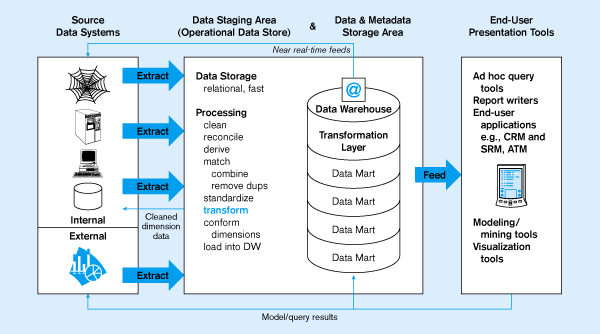
Figure 1: Diagram illustrating the relationship between logical data marts, ODS, and the data warehouseSource: ETLmodelling.pdf (Page 18)

Figure 2: Diagram of data warehouse architecturesSource: ETLmodelling.pdf (Page 14)
Subtopics & Sections
Star schemas provide a simple, intuitive conceptual model that centers a fact table surrounded by dimension tables, enabling efficient multidimensional analysis in data warehouses.
The fundamentals of multidimensional data modeling describe how data warehouses organize facts, measures, and hierarchical dimensions into cubes and schemas to support analytical decision‑making.
Schema variants—star, snowflake, and fact constellation—are distinct dimensional modeling patterns that organize facts and dimensions to support different analytical and performance requirements in a data warehouse.
Related Topics
Incoming Backlinks
Other pages in this wiki that link back to the current topic.
## ETL modelling - Overview
A comprehensive guide to ETL modelling that integrates conceptual design, multidimensional schemas, data‑warehouse architectures, and transformation techniques for robust data reconciliation.
Fundamentals of Multidimensional Data Modeling
The fundamentals of multidimensional data modeling describe how data warehouses organize facts, measures, and hierarchical dimensions into cubes and schemas to support analytical decision‑making.
Conceptual Modeling Using Star Schemas
Star schemas provide a simple, intuitive conceptual model that centers a fact table surrounded by dimension tables, enabling efficient multidimensional analysis in data warehouses.
Schema Variants in Dimensional Modeling
Schema variants—star, snowflake, and fact constellation—are distinct dimensional modeling patterns that organize facts and dimensions to support different analytical and performance requirements in a data warehouse.