Fundamentals of Multidimensional Data Modeling
Verified Concept Article • Factual Traceability Enabled
Summary OverviewThe fundamentals of multidimensional data modeling describe how data warehouses organize facts, measures, and hierarchical dimensions into cubes and schemas to support analytical decision‑making.
Overview
A multidimensional data model is the backbone of a data warehouse, presenting information as a data cube that can be examined from many perspectives. This model enables decision makers to slice, dice, and aggregate data across business subjects such as sales, customers, or products, aligning with the warehouse’s subject‑oriented, time‑variant, and non‑volatile nature【Source 4†L1-L4】【Source 7†L1-L4】.
Core Components of the Multidimensional Model
The model distinguishes two primary table types. Dimension tables store descriptive attributes—e.g., an item dimension may contain item_name, brand, and type, while a time dimension records day, week, month, quarter, and year【Source 1†L4-L5】. These tables capture the hierarchical relationships that users navigate during analysis. Fact tables hold quantitative measures such as dollars_sold or units_sold and foreign keys linking each record to the relevant dimensions【Source 1†L6-L7】. Facts represent business processes that evolve over time, and every fact is intrinsically associated with a temporal dimension, ensuring that historical trends can be examined【Source 2†L1-L4】.
Cuboids and the Data Cube Lattice
In multidimensional terminology, an n‑D base cube is called a base cuboid. By aggregating across dimensions, the model generates lower‑dimensional cuboids, culminating in the apex cuboid (a 0‑D summary) that holds the highest‑level totals【Source 1†L8-L10】. All possible cuboids together form a lattice, providing a systematic structure for pre‑computing and retrieving aggregates efficiently.
Schema Variants
The logical arrangement of fact and dimension tables is expressed through several well‑known schemas. The star schema places a single fact table at the center, surrounded by denormalized dimension tables, yielding a simple, high‑performance layout【Source 3†L1-L2】. When dimension hierarchies are normalized into multiple related tables, the design becomes a snowflake schema, resembling a snowflake pattern【Source 3†L2-L3】. For more complex analytical needs, fact constellations (or galaxy schemas) share dimension tables among multiple fact tables, supporting diverse business processes within a unified warehouse【Source 3†L3-L4】.
Temporal and Subject Orientation
A data warehouse stores data over long horizons—often five to ten years—providing a historical view absent from operational systems, which retain only current values【Source 11†L1-L4】. Each key in the warehouse implicitly or explicitly contains a time element, enabling trend analysis and period‑over‑period comparisons. Because the warehouse is non‑volatile, data are loaded once via ETL processes and thereafter remain unchanged, eliminating the need for transaction processing, recovery, or concurrency control mechanisms【Source 12†L1-L5】.
Design Considerations
Designing a multidimensional model begins with identifying measures and facts, a step that is typically manual and critical to success【Source 6†L1-L3】. Once facts are defined, dimension hierarchies are categorized, and appropriate schema variants are chosen based on query patterns and performance requirements. Automated schema‑design tools can assist, but the conceptual modeling phase—defining objects, their properties, and associations—remains essential for a robust, decision‑supportive warehouse【Source 2†L5-L8】【Source 5†L3-L5】.
By integrating these elements—cubes, cuboids, dimensions, facts, and schema designs—multidimensional data modeling furnishes a flexible, intuitive framework that underpins modern analytical processing within data warehouses.
Visual References from Cited Pages
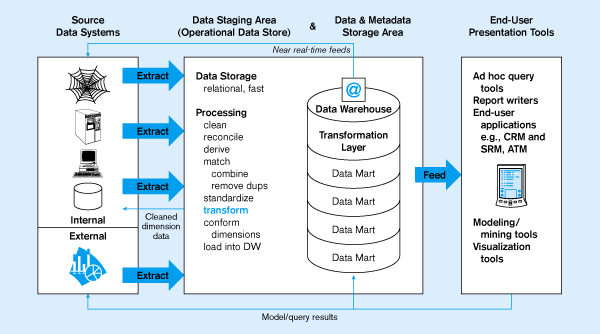
Figure 1: Diagram illustrating the relationship between logical data marts, ODS, and the data warehouseSource: ETLmodelling.pdf (Page 18)

Figure 2: Diagram of data warehouse architecturesSource: ETLmodelling.pdf (Page 14)
Related Topics
Incoming Backlinks
Other pages in this wiki that link back to the current topic.