Point-to-Point Interface Complexity in System Integration
Verified Concept Article • Factual Traceability Enabled
Summary OverviewPoint-to-point interfaces create dense, hard‑to‑manage connections that amplify integration complexity, prompting the need for higher‑level abstraction approaches.
Definition and Characteristics
Point‑to‑point (P2P) interfaces are direct communication links established between two individual systems or components. Each link carries its own protocol, data format, and transformation logic, resulting in a network of bespoke connections. While the source evidence (Pages 8‑9) only provides a visual label for this concept, the broader literature describes point‑to‑point as the most granular integration style, where every new system added to an enterprise requires a new dedicated interface.
Drivers of Complexity
The Complexity of Data Interfaces outlined on page 7 highlights several forces that aggravate point‑to‑point growth:
- Changing computer systems: As legacy applications are replaced and new platforms are introduced, data must be converted between formats, requiring fresh interfaces for each pair of systems.
- Reporting and analysis needs: Integrated data is essential for enterprise reporting, compelling organizations to build additional links to feed data into analytics layers.
- Business transaction processing: Real‑time transaction flows demand tight coupling, often implemented as direct connections to avoid latency.
Each of these drivers multiplies the number of required point‑to‑point links, and the source notes that “complexity of the interfaces between the systems increases, when more systems are added.”
Consequences for System Portfolios
When an organization relies heavily on point‑to‑point wiring, the integration landscape becomes a tangled web. Maintenance effort rises because any change to a single system may cascade across dozens of interfaces. Moreover, the Rise of Purchased Vendor Packages (COTS software) on page 9 shows that while off‑the‑shelf solutions can reduce development effort, they still need to be hooked into the existing point‑to‑point mesh, preserving the underlying complexity. Vendors may design their products to support integration, yet the unique combination of systems in each organization means bespoke adapters are still required.
Comparative Integration Strategies
To mitigate the drawbacks of pure point‑to‑point wiring, enterprises adopt higher‑level integration mechanisms:
- Integration by Applications (page 24) uses a small set of integration applications that query multiple sources and return consolidated results. This approach works for a limited number of components but becomes unwieldy as the number of interfaces and data formats grows.
- Integration by Middleware (page 25) introduces a shared service layer that abstracts communication details. Middleware can provide routing, transformation, and messaging capabilities, yet different middleware tools often need to be combined, adding its own layer of complexity.
- Peer‑to‑Peer (P2P) Integration (page 45) offers a decentralized model where distributed peers share data directly. Depending on the functionality exposed, it can act as a uniform data‑access façade or simply provide common data points for later manual integration.
Mitigation through Abstraction Hierarchies
The broader theme of Managing Interface Complexity Through Abstraction Hierarchies recommends placing point‑to‑point connections beneath higher‑level abstractions—such as service‑oriented APIs, enterprise service buses, or data virtualization layers. By encapsulating many low‑level links behind a single logical interface, organizations reduce the visible surface area of complexity, simplify change management, and improve scalability. In practice, this means transitioning from a dense web of direct links to a structured hierarchy where point‑to‑point interactions are hidden behind reusable, well‑defined services.
Overall, while point‑to‑point interfaces are a natural starting point for system integration, their inherent scalability limits make abstraction hierarchies essential for sustainable enterprise architecture.
Visual References from Cited Pages
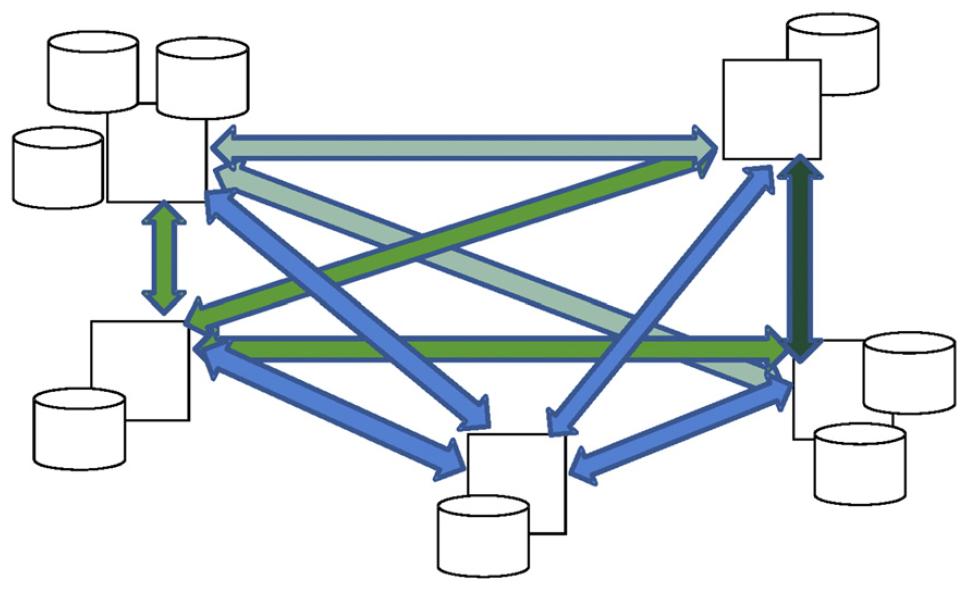
Figure 1: Diagram illustrating point-to-point interface complexitySource: DataIntegration.pdf (Page 8)
Related Topics
Incoming Backlinks
Other pages in this wiki that link back to the current topic.